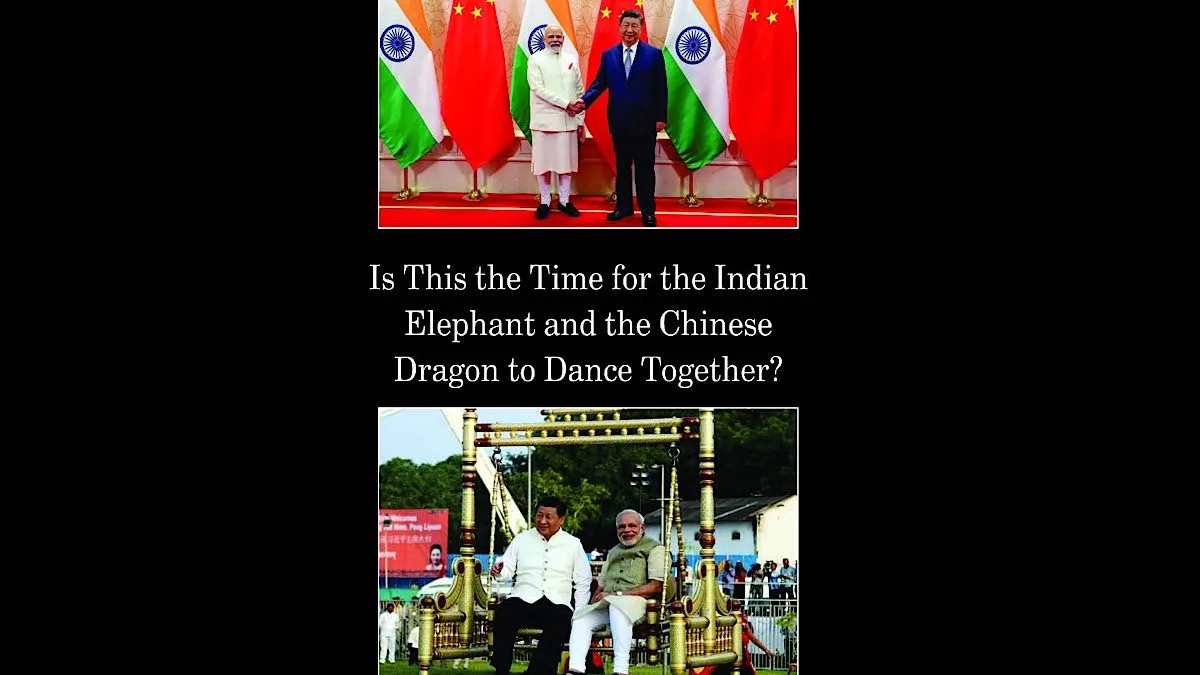
“Is This the Time for the Indian Elephant and the Chinese Dragon to Dance Together?” The title of a new book raises a pertinent question at an opportune time when India and China are cautiously engaged in rebuilding high-level diplomatic engagement after years of military confrontation.
The October 2024 border disengagement agreement, subsequent ministerial exchanges, and the restoration of summit-level dialogue have resurfaced the difficult question: can the two Asian giants compete without colliding? Rather than offering a single answer, former diplomat Surendra Kumar has assembled 14 essays by seasoned practitioners of Indian foreign policy that grapple with this question from multiple vantage points.
Advertisement
The book’s greatest strength lies in its contributors. Former foreign secretaries Shyam Saran and Nirupama Rao, diplomats such as TCA Raghavan, and parliamentarian Shashi Tharoor, among others, bring decades of experience to the discussion. As Kumar notes in the preface, the volume is not intended as a “report card” on India-China ties but an attempt to assess the prospects of a “more productive relationship” while remaining grounded in recent realities.
The essays avoid both triumphalism and pessimism. Instead, they acknowledge that the relationship has fundamentally changed after the 2020 Galwan clash. In the opening chapter, Shyam Saran argues that India-China relations are moving only “gradually and fitfully” towards normality following the October 2024 disengagement agreement. Yet, he cautions against confusing disengagement with restoration of the status quo. According to Saran, both countries continue to station roughly 50,000 troops along the Line of Actual Control, making the military stand-off a continuing strategic reality rather than a closed chapter.
Saran’s chapter is among the most compelling because it captures the paradox defining the bilateral relationship. He welcomes renewed diplomatic engagement, including Chinese Foreign Minister Wang Yi’s visit to India and the resumption of summit meetings, but insists that structural competition will endure. His observation that India and China agree on global multipolarity while fundamentally disagreeing on what multipolarity means within Asia neatly encapsulates one of the book’s central arguments. For Beijing, Asia has a natural hierarchy; for New Delhi, it remains a contested strategic space with multiple centres of power.
Economic interdependence emerges as another recurring theme. Saran acknowledges India’s growing dependence on Chinese intermediate goods, electronics components and rare earths while simultaneously arguing that strategic sectors such as telecommunications and the digital economy require caution. Rather than advocating wholesale economic decoupling, he proposes calibrated engagement, cooperation where beneficial and restrictions where national security demands it.
TCA Raghavan broadens the discussion by placing India-China relations within a wider geopolitical framework. His analysis suggests that the bilateral equation cannot be separated from shifting US-China rivalry, South Asian geopolitics or China’s expanding influence across the Global South. Together, the essays demonstrate that India-China relations are no longer merely about an unresolved border but about competing visions of regional order, technology, trade and global governance.
The editor deserves credit for resisting the temptation to produce a consensus volume. As he writes in the preface, readers may not agree with every contributor, but the essays are intended to provoke reflection rather than prescribe doctrine. That diversity of perspectives gives the collection intellectual credibility.
If the book has a limitation, it is that many contributors come from India’s strategic establishment, resulting in perspectives that are broadly aligned even when they differ in emphasis. The absence of Chinese scholarly voices means the dialogue remains largely one-sided. Yet this is also an honest reflection of current political realities, where trust remains fragile despite renewed engagement.
At a time when India and China are cautiously reopening channels of communication while remaining strategic competitors, Is This the Time for the Indian Elephant and the Chinese Dragon to Dance Together? provides a thoughtful, timely and accessible guide to one of the world’s most consequential bilateral relationships. It does not promise easy answers, but it succeeds in framing the right questions, and, in today’s geopolitical climate, that may be its most valuable contribution.